Ayin Tovah – Choosing the Truth to Illuminate
Video Available: https://www.youtube.com/watch?v=7W76yx45k7o
Ayin Tovah – Choosing the Truth to Illuminate
Rabbi Shimon bar Yochai emerged from 12 years in a cave with a gaze that burned everything it touched — and his story, woven through Iyar and Lag BaOmer, teaches us that ayin tova (a good eye) is not naivety but a daily discipline of choosing which truths we illuminate and what kind of world we participate in creating.
There is a quiet but powerful teaching woven through Jewish thought: we do not only encounter the world—we interpret it and actively help in creating it. And in that interpretation lies a profound choice about what we see and how we see it. This is called Ayin Tova—a "good eye," a generous, expansive way of seeing. Its opposite, an evil eye, is a way of looking that fixates on lack, judgment, and deficiency. In Pirkei Avot (studied in this time between Pesach and Shavuot), Rabban Yochanan ben Zakkai asks his students: "Which is the good path a person should choose?" Rabbi Elazar ben Arach answers: Ayin Tova. And his teacher affirms that this path encompasses all the other opinions including having a good heart, being a good friend or neighbor and having foresight (2:9).
Ultimate truth belongs to the Ribbono Shel Olam. As human beings, we only see facets of a greater whole — like a hammer shattering rock into many sparks (Yirmiyahu 23:29, see Talmud Sanhedrin 34a)—our reality is rich with multiple, simultaneous meanings. This idea is vividly seen in the story of Rabbi Shimon bar Yochai, whose life and Torah legacy is celebrated on the 18th of Iyar. After 12 years hidden in a cave with his son, immersed entirely in Torah, they emerge into a world of farmers, laborers, ordinary life. What they see unsettles them. How can people turn from eternal matters to temporal ones?
A Burning Gaze
The Talmud tells us that wherever they cast their eyes, things were burned. Their vision itself becomes fire—sharp, absolute, uncompromising. It is a gaze of pure דין, strict judgment, a world measured only against the highest standard. And such a vision, even if rooted in truth, leaves no room for human life.
כׇּל מָקוֹם שֶׁנּוֹתְנִין עֵינֵיהֶן מִיָּד נִשְׂרָף. יָצְתָה בַּת קוֹל וְאָמְרָה לָהֶם: לְהַחֲרִיב עוֹלָמִי יְצָאתֶם?! חִיזְרוּ לִמְעָרַתְכֶם!
A heavenly voice sends them back: "Have you come out to destroy My world? Return to your cave (Talmud Shabbat 33b)."
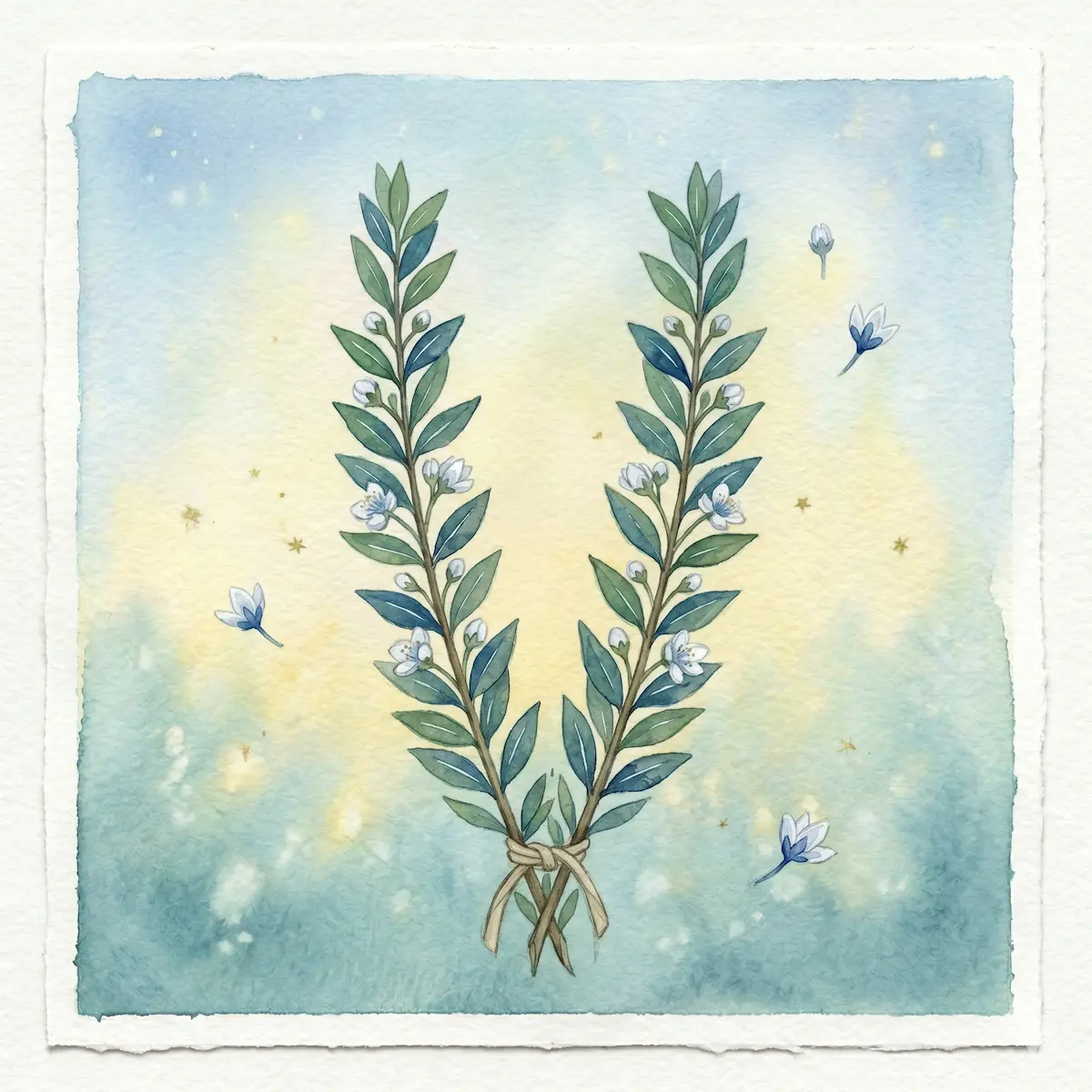
After a rehabilitation of twelve months, one month per year in the cave, they emerge again. And this time, something has shifted. They encounter an elderly man at twilight on Friday afternoon, holding two bundles of hadasim. When asked why one will not suffice, he explains: one is for "Zachor"—to remember the Shabbat—and one for "Shamor"—to guard it. At that moment, Rabbi Shimon turns to his son and says: "See how beloved the mitzvot are to Israel."
The same world. Different eyes.
Din and Rachamim
But the detail of the two myrtle branches opens a deeper layer. Zachor and Shamor, as expressed in the two versions of the Ten Commandments, represent two dimensions of Shabbat. Shamor is restraint: boundaries, discipline, the "no." Do not work. Do not create. It is structure, דין. Zachor is presence: sanctification, delight, memory, the "yes." It is expansiveness, רחמים. The man is not choosing between them. He is carrying both.
And perhaps this is precisely what Rabbi Shimon needed to learn through the symbol of the hadasim themselves, one of the four species of Sukkot, which represent our eyes. Rashbi's initial destructive, burning gaze was trying to live up to an unyielding, uncompromising ideal. The second time, he sees a world that holds both דין and רחמים, both discipline and love. A world where holiness lives not only in separation from life, but within it. This is the only way the world can survive. The midrash (Mechilta de-Rabbi Yishamael 20:8) states that Hashem uttered both Shamor and Zachor simultaneously, highlighting that din and rachamim, judgement and mercy, are two essential aspects of Shabbat, and ultimately the creation of the world (see Rashi Bereishit 2:4).
This is Ayin Tova in its deepest sense. Not naïveté, not denial—but integration. This balance finds another expression in the light of Shabbat itself. Traditionally on erev Shabbat, two Shabbat candles are lit, corresponding to Zachor and Shamor. Chazal teach that the dual flames of nerot Shabbat are for shalom bayit—to bring peace into the home.
It is fire — transformed.
Not the destructive fire of Rabbi Shimon's first gaze, which consumes and erases. But a gentle, illuminating flame that makes space for life, that softens edges, that allows people to see one another with warmth.
The Choice
The remarkable author, Holocaust survivor, Dr. Edith Eger, who passed away this week, reflected on survival and healing in her book The Choice. She emphasized that we have a choice: to pay attention to what we've lost or to pay attention to what we still have. This is not a denial of pain. It is a discipline of attention. She writes, "And here you are, in the sacred present. You can't change what happened…but you can choose how you live now."
Contemporary psychology echoes this with clarity: attention is not neutral. What we consistently focus on shapes our emotional world, our resilience, even our sense of meaning. We do not control what happens to us—but we participate in shaping the reality we live in by choosing what to notice.
Ayin Tova is not simply a trait. It is a practice. A decision, moment by moment, about where to direct the light of our awareness. We choose which parts of our experience to illuminate.
And that choice has consequences.
A judging eye constricts the world. It reduces people to their deficiencies, highlights their failures. It creates a reality that feels harsh, brittle, and often unlivable. A good eye expands the world. It notices effort, meaning, small goodness. It creates the conditions under which people—and relationships, and even the self—can grow.
Rabbi Shimon does not abandon truth. He refines it. He learns that truth, when stripped of רחמים, becomes destructive. And that the Divine desire is not for a world that meets an impossible standard, but for a world that can exist, be sustained, and be elevated.
Like the man running with the hadasim, like the candles we light each Friday evening, we are always holding both truths in our hands. We choose with our eyes. We choose what to emphasize. We choose what kind of world we participate in creating.
We can look with an eye that burns—or an eye that brings light.
The question is not what is true, it's what truth will we choose to illuminate?
Originally published on Matan.
Related Articles
You might also be interested in these teachings
Optimism in Iyar
Rabbi Akiva lost twenty-four thousand students, stood at the ruins of the Temple, and laughed — because Rachel had taught him to see greatness hidden in plain sight, and we can learn from their partnership to begin again even in the ashes.
Read MoreHealing Our Wounds
In Av — the month whose very name means Father — we discover that honoring our imperfect parents carries a promise deeper than long life: arukhah (healing), the slow closing of the wounds we all carry, and a softening of how easily the word Avinu, our Father, forms in our mouths.
Read MoreTammuz and the Challenge of Not Knowing
Tammuz opens in the ache of not-knowing — the very intolerance of uncertainty that once pushed our ancestors toward the golden calf — yet its deeper invitation is to build the spiritual muscle that lets us wait, with emunah (faith), even when the answers have not yet come.
Read More