Rediscovering Paradise
Rediscovering Paradise
Our minds are wired to fixate on what is missing, so each Tishrei we step out of our sturdy homes into a fragile sukkah, read Kohelet's reminder that everything is fleeting, and return to the story of Gan Eden — all to learn that we don't need more to feel abundance, we need to see more of the paradise we already have.
The Paradise We Stop Noticing
Our thought patterns possess a peculiar design. The common human tendency towards negativity bias originates in the brain’s primal obsession with scanning for threats and tracking deficiencies. Unfortunately this can set us up for stubborn loops which point out everything that is wrong or may go wrong, while making it easy for us to ignore the things that are going right.
In the song Big Yellow Taxi, Joni Mitchell famously sings, “Don’t it always seem to go that you don’t know what you’ve got till it’s gone. They paved paradise and put up a parking lot.” Written by Mitchell in 1970 while on a trip to Hawaii when she looked out at the beautiful green mountains ahead of her as they sharply contrasted with a massive parking lot in the same scene. It was a “blight on paradise.” And a song was born.
The irony is that we all live in more of a paradise, or Gan Eden, than we realize. Yet often we normalize and overlook our blessings with terrifying speed. The solid roof over our heads, the insulation blocking the chill, the quiet certainty of a stocked pantry—these do not register as triumphs to a brain programmed to fixate exclusively on what is missing or what might go wrong.
The Torah, with its deep and timeless comprehension of the human psyche, anticipated this precise vulnerability. When things are going well, we can easily forget to be thankful. We forget to see God in our lives:
When you have eaten your fill, and have built fine houses to live in…beware that you don’t forget Hashem…(Devarim 8:12-14)
Sukkot arrives each year as a brilliant, divine cognitive intervention.
We build a home without the solid roof over our heads, without insulation, and without the stocked pantry or even a kitchen. We create a controlled, voluntary simulation of loss. We step out of our secure homes which we have grown accustomed to, which we so easily take for granted, and we enter a simple, vulnerable existence.
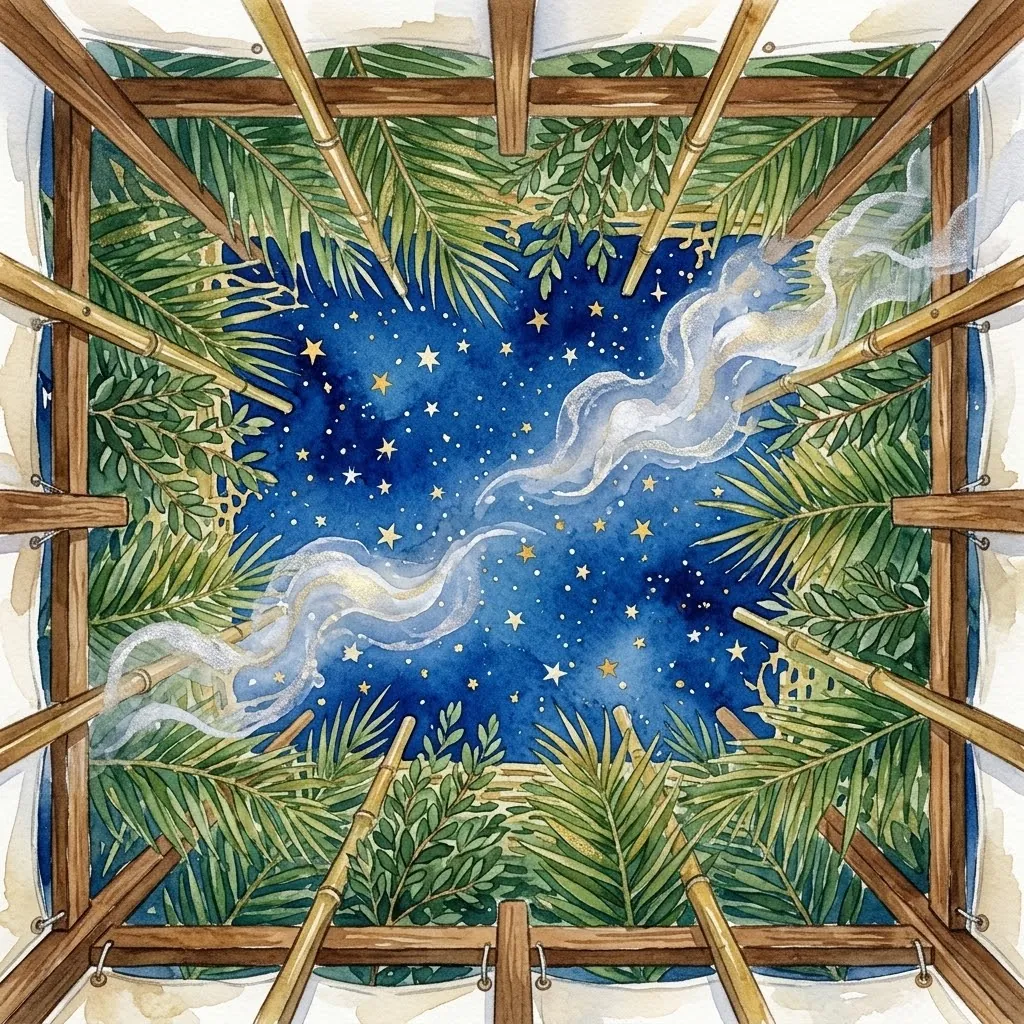
The temporary schach over our heads represents the Ananei HaKavod, the divine Clouds of Glory that sheltered our ancestors in the wilderness. In the language of modern psychology, the sukkah experience invites us to practice a radical cognitive reframing. It trains the eye to peer through the gaps in a fragile roof and see not a lack of shelter, but an abundance of twinkling stars, or the swaying branches of schach.
We appreciate the sanctuary of our fixed homes and sturdy roofs even more because we have momentarily let them go. The absence of our usual comforts can heighten our awareness and appreciation for all that we usually have.
Sometimes we need to do without in order to help us recognize the paradise that has become normal.
Even Paradise is Temporary
To take it a step further, on Sukkot we are reminded that recognizing the blessings in our lives comes with an important caveat:
The greatest gifts are fleeting.
Gratitude is not something that happens automatically when life is flawless. It is a deliberate choice to notice the good that we do have—even when that good is as ordinary as a home-cooked meal or a cool glass of water.
The traditional reading of Kohelet on Sukkot repeatedly remind us of the temporary nature of everything:
הֲבֵל הֲבָלִים אָמַר קֹהֶלֶת הֲבֵל הֲבָלִים הַכֹּל הָבֶל
Many translations of this verse from Kohelet (1:2; see also 12:8) render hevel as “futility” or “vanity.” But the Hebrew word more literally evokes breath or vapor—something fleeting, insubstantial and impossible to hold onto. The word appears repeatedly (38 times) throughout Kohelet, underscoring the book’s central awareness of impermanence.
At first glance, this seems like a very different message from gratitude. If everything is temporary, why invest ourselves in anything?
But perhaps that is precisely Kohelet’s point. The fact that something will not last does not make it worthless. It makes it precious.
The sukkah itself embodies this paradox. We are asked to rejoice in a temporary dwelling, to decorate it, eat in it, invite guests into it, and call it our home for seven days. Its impermanence does not diminish the experience. In some sense, it intensifies it.
Kohelet presents a similar challenge: because life cannot be fully grasped or controlled, we should stop obsessing over the relentless pursuit of achievement, wealth or knowledge as though these things could provide permanent security. Instead, Kohelet repeatedly encourages us to eat, drink, experience joy in our labor, and receive the blessings of the present moment as gifts from God (Kohelet 2:24; 3:13; 5:18).
The message of Kohelet is not: “everything is worthless,” or “nothing matters.” It is almost the opposite:
Because everything is fleeting, revel in the beauty in what is here now.
In The Beginning
On Shemini Atzeret we begin the story of creation and subsequently on the following Shabbat, we read the entirety of Bereishit. We’re reminded that this tendency to lose sight of our blessings is not merely a modern psychological phenomenon. It is woven into the very beginning of the human story.
It seems to be etched in our DNA to lose sight of all of the bounty that we have before us and instead focus on what we don’t or can’t have. This is the story of Adam and Chava, who live in the original paradise. Every delectable tree in the garden of Eden was available to them (Bereishit 2:16). All except one (2:17).
And as we know, the first sin of humankind entails eating from the one tree that was not meant for them.
The problem is certainly not that Adam and Chava lacked abundance. The problem is that the one thing they lack became more psychologically powerful than everything they had.
And perhaps we recognize ourselves in that story.
We can have a loving family and focus on the one relationship that feels distant. We can have a comfortable home and obsess over the thing that’s broken. We can have meaningful work and fixate on the promotion we didn’t get. We can experience a beautiful walk in nature on a Tuesday—and spend the day ruminating over the trail we didn’t take.
Returning To Paradise, Again
We leave our comfortable homes so we can return to them and notice how extraordinarily wonderful they were all along.
We learn from Kohelet that all is temporary, and that impermanence can help us cherish the moments in our lives even more.
And we return to Gan Eden to confront the human tendency in us all: allowing what we lack to get more attention than what we have.
All three messages share a common thread: We do not need to have more in order to experience greater abundance. We need to see more of what we already have. And what we have is our personal paradise.
Originally published on Matan.
Related Articles
You might also be interested in these teachings
Mind First, Then Heart
When genuine happiness feels impossible, the Tishrei journey from Rosh Hashana to Sukkot teaches us that the mind must awaken first — letting our thoughts about God's presence rule our emotions — so that the heart can open into real joy.
Read MoreAn Embrace from God
When life feels as fleeting and unsteady as a sukkah, the very walls around us — two full walls and a handsbreadth of a third — are the kabbalistic shape of a one-armed hug from God, His right arm embracing us.
Read MoreThe Letter Yud
Every Hebrew letter begins with a yud, the smallest stroke of the scribe's quill, and in Elul we are invited to set aside the roles and layers we've gathered all year and search for that tiny, eternal point at our core — because teshuvah (return) may be less about changing than about remembering who we have always been.
Read More